How to Choose the Right Interior Designer for Your Dubai Home
Understanding Your Needs and Design Vision
Define Your Project Type
Project type dictates designer specialization requirements. A complete villa redesign demands different expertise than a high-rise apartment fitout or a single-room kitchen remodel. Residential interior designers in Dubai operate across four primary categories: full apartment renovations, villa interiors with outdoor integration, luxury residential fitouts, and room-specific transformations. Match your project category to a designer's documented track record in that exact domain.
Identify Your Design Style
Design style alignment prevents costly revisions during execution. Collect reference images from architectural publications, design platforms, and completed project galleries. Organize these into a visual brief that communicates your aesthetic direction — whether that's modern minimalism, contemporary Arabic fusion, Scandinavian restraint, or layered maximalism. A precise visual brief reduces concept development cycles and accelerates design approval.
Set Your Budget Range
Budget parameters govern material specifications, execution scope, and designer tier. Establish your total investment ceiling — covering design fees, materials, contractor costs, and a contingency reserve of 10–15%. Communicate this figure directly to candidates. Designers calibrate their material sourcing, supplier selections, and execution methodologies to your defined financial parameters.
Establish Your Timeline
Project duration in Dubai residential design ranges from 6 weeks for targeted interventions to 9 months for full villa transformations. A defined completion date filters out designers with conflicting project commitments and ensures you engage professionals who allocate adequate team capacity to your timeline.

Researching and Vetting Interior Designers
Check Their Portfolio and Experience
A designer's portfolio constitutes the primary qualification document. Request projects that match your scope in scale, style, and spatial complexity. Evaluate portfolio depth across three dimensions: stylistic range, execution quality, and Dubai-specific residential experience. Designers with established Dubai project histories possess verified knowledge of local building regulations, approved material suppliers, contractor ecosystems, and municipality submission processes — operational advantages that directly reduce your project risk.
Examine portfolio photography critically. Professionally presented, well-lit finished spaces signal quality control standards. Repetitive, formulaic outputs across projects signal limited creative range.
Look for Relevant Certifications and Credentials
Professional credentials establish baseline competency standards. In the UAE market, recognized affiliations include memberships with the American Society of Interior Designers (ASID), the British Institute of Interior Design (BIID), or equivalent accredited bodies. Continuing professional development certifications confirm active engagement with current design standards, material innovations, and regulatory updates.
Read Client Testimonials and Reviews
Client reviews reveal operational performance beyond portfolio aesthetics. Evaluate Google Business reviews, project-specific testimonials, and direct client references across five performance dimensions: communication responsiveness, timeline adherence, budget accuracy, problem resolution, and final output quality. Contact previous clients directly. Request specific data points: actual vs. quoted budget variance, timeline deviation in weeks, and whether they would commission the same designer again.
Verify Their Local Reputation
Dubai's interior design ecosystem operates on professional reputation networks. Architects, general contractors, and premium furniture suppliers regularly evaluate designer performance through shared project experience. Solicit direct assessments from these adjacent professionals about candidates on your shortlist. Strong cross-industry relationships confirm operational reliability and payment integrity — factors that protect your project's supply chain and execution schedule.
Evaluating Services and Approach
Full-Service vs. Consultation-Only
Full-service interior design firms deliver an integrated scope: concept development, 3D visualization, material specification, procurement, contractor coordination, site supervision, and final handover. Consultation-only models provide design direction and specifications while the client manages execution independently. Full-service engagement reduces client coordination burden, consolidates accountability, and produces higher execution fidelity. Identify your capacity for project involvement and select the service model that matches your available time and operational preference.
Design Process and Methodology
A structured design methodology produces measurable output consistency. The standard professional sequence includes: discovery consultation, lifestyle and spatial analysis, concept development, 3D visualization, material and finish specification, procurement coordination, and supervised execution. Designers who initiate the process with in-depth client profiling — capturing daily routines, entertaining habits, family dynamics, and ergonomic requirements — deliver spaces engineered for actual use, not visual presentation alone.
Technology and Visualization Capabilities
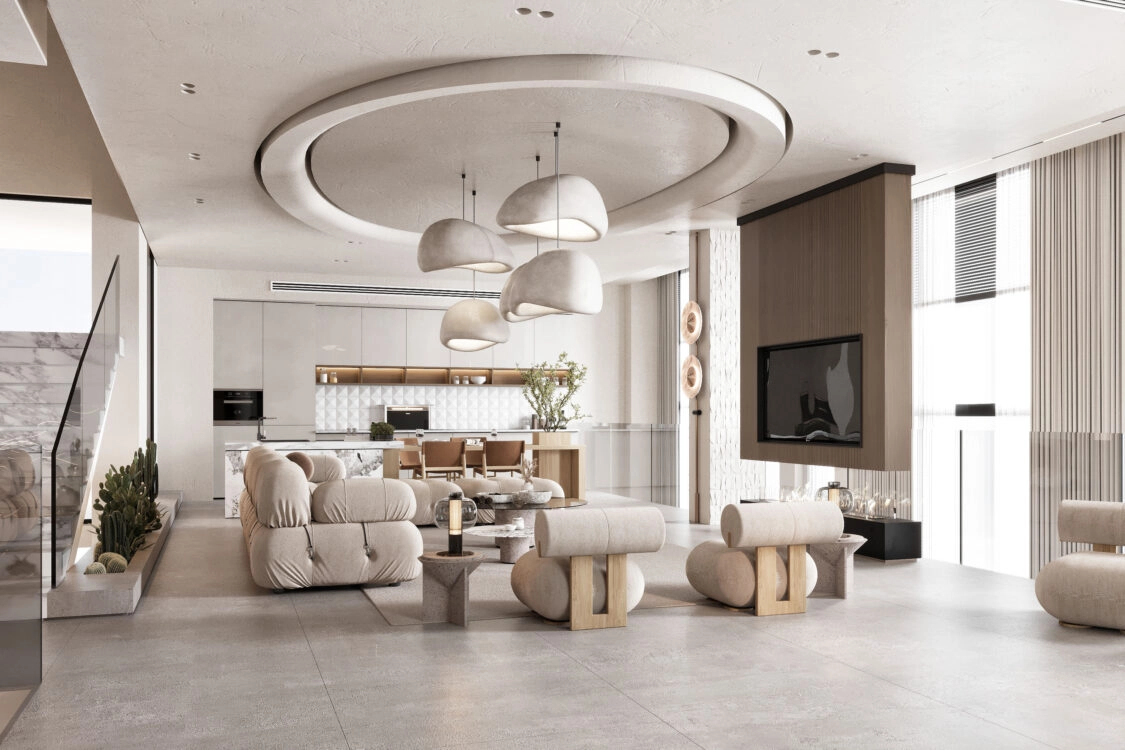
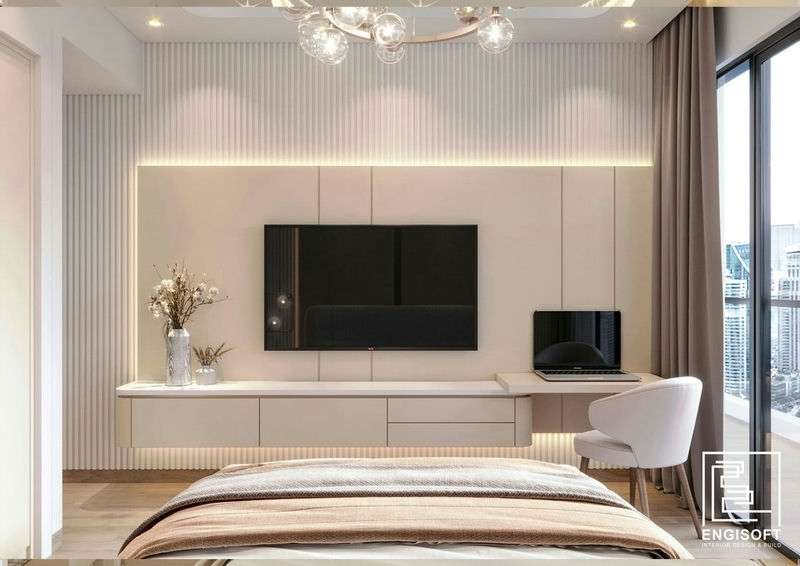
3D photorealistic rendering is a non-negotiable technical capability for Dubai residential projects. High-fidelity renderings allow design validation, material comparison, and spatial layout confirmation before a single material purchase or structural modification. Verify that candidate designers produce photorealistic renders — not basic 3D models — and support iterative revision cycles within the visualization phase. This capability eliminates execution-stage design changes, which carry 3–5× the cost of pre-execution revisions.
Project Management and Coordination
Project management competency determines whether your project delivers on time and within budget. Evaluate candidates on four management dimensions: multi-trade coordination experience, procurement timeline control, budget tracking methodology, and change-order management protocols. Designers with documented project management systems — including progress reporting schedules and issue escalation procedures — reduce costly delays and contractor coordination failures.
Assessing Communication and Compatibility
Schedule Consultation Meetings
Conduct in-person or video consultations with shortlisted candidates. Observe listening behavior. Designers who ask detailed questions about your lifestyle, daily movement patterns, and spatial priorities before proposing solutions demonstrate client-led design discipline. Designers who advance their aesthetic preferences before understanding your requirements impose creative direction rather than serve your brief.
Clarify Communication Protocols
Establish communication standards before engagement. Confirm the primary communication channel — structured email threads, project management platforms, or WhatsApp — and the expected response time for standard queries. Define update frequency: weekly progress reports, milestone-based briefings, or on-demand communication. Clear protocols prevent information gaps that cause decision delays and execution errors.
Assess Problem-Solving Approach
Construction projects in Dubai encounter site condition variances, material lead-time disruptions, and specification changes. A designer's problem-solving orientation reveals their operational competency. Ask candidates directly how they managed a significant project disruption. Evaluate their response for proactive solution development, transparent client communication, and outcome accountability. Problem-solvers who absorb operational complexity protect your timeline and budget.
Understanding Fees and Contracts
Understand Fee Structures
Dubai interior designers operate across four primary fee models: hourly billing, fixed project fees, percentage-of-cost structures (typically 10–20% of total project spend), and hybrid combinations. Each model carries different risk and incentive profiles. Fixed project fees provide budget certainty. Percentage-based fees align designer incentives with project quality but require rigorous procurement oversight. Request itemized fee proposals in writing from all shortlisted candidates for direct comparison.
Request a Detailed Contract
A professional engagement contract specifies: defined scope of work, milestone-based payment schedule, revision allowance limits, intellectual property ownership, timeline commitments, and dispute resolution procedures. Contracts without scope definitions expose you to fee escalation. Contracts without revision limits create unlimited design cycle costs. Review every contractual clause before signature.
Clarify What's Included and Excluded
Separate design fees from execution costs in your financial model. Confirm whether the designer procures materials directly or issues specifications for independent procurement. Establish who manages contractor relationships, who holds contractor contracts, and who bears liability for workmanship defects. Define the cost and process for scope expansions. These clarifications eliminate the most common sources of post-contract financial disputes.
Making Your Final Decision
"The designer you choose transforms your residential space into a precisely designed environment that delivers functional and aesthetic value for years."
Create a Comparison Matrix
Evaluate shortlisted candidates across six weighted criteria: portfolio relevance to your project type, verified Dubai residential experience, service scope completeness, communication responsiveness observed during vetting, fee structure transparency, and contractual clarity. Assign numerical scores to each criterion. This structured comparison eliminates selection bias and produces a defensible, data-supported decision.
Trust Your Instincts
Objective scoring surfaces qualified candidates. Intuitive assessment surfaces the right partner. A designer whose credentials are strong but whose communication style creates friction produces a difficult project experience. A designer who demonstrates genuine curiosity about your life, your preferences, and your vision builds the collaborative foundation that great residential projects require.
Verify References One More Time
Contact a minimum of two recent clients before contract execution. Request specific project outcome data: final cost vs. initial quote, actual completion date vs. contracted date, and post-handover issue response. This final verification confirms that vetting data translates into consistent real-world performance.
- Portfolio reviewed against your project type
- Dubai-specific project history confirmed
- Client references contacted directly
- Fee structure documented in writing
- Contract scope and exclusions clarified
- Communication protocols established
Choosing Engisoft Interiors for Your Dubai Home
Engisoft Interiors delivers full-service residential interior design across Dubai and the UAE, combining technical precision with client-centered design methodology. Every project follows a structured process — from discovery consultation through supervised execution — with a single accountable team managing every detail.
Verified Portfolio Depth
Completed residential projects across apartments, villas, and luxury fitout categories, documented with professional photography and measurable client outcomes.
Integrated Service Scope
Concept development, photorealistic 3D visualization, material specification, procurement coordination, and full project management under a single accountable team.
Advanced Visualization
Photorealistic rendering systems that validate your complete design — finishes, furniture, spatial layout, and lighting — before execution commences.
Dubai Market Expertise
Established supplier networks, current knowledge of Dubai Municipality regulations, and contractor relationships built across years of active residential project delivery.
Structured Design Process
A client profiling methodology capturing lifestyle requirements, spatial usage patterns, and aesthetic priorities before any concept is proposed.
Delivery Accountability
Project management systems tracking budget, timeline, and contractor performance with transparent client reporting at every milestone.
Transform Your Dubai Home with Precision Design
Consult with Engisoft Interiors to define your project scope, explore 3D visualization capabilities, and receive a detailed service proposal tailored to your residential brief.
Begin Your ConsultationConclusion
The right interior designer for your Dubai home combines technical qualification, operational reliability, and genuine alignment with your vision. A structured selection process — built on portfolio verification, service scope evaluation, financial clarity, and communication compatibility — produces the conditions for a successful project.
Defining your project type, budget, and timeline creates a precise brief. Vetting portfolios, credentials, and client references surfaces proven performers. Evaluating process methodology and 3D visualization capabilities confirms technical readiness. Clarifying contracts and fee structures eliminates financial ambiguity.
Execute this selection process with rigor. The designer you choose transforms your residential space into a precisely designed environment that delivers functional and aesthetic value for years.
Frequently Asked Questions
-
What is the typical cost of hiring an interior designer in Dubai?Interior design fees in Dubai range from AED 150–500 per square foot for full residential fitouts, depending on material tier, project complexity, and service scope. Designer fees typically represent 10–20% of total project cost under percentage-based models, or are quoted as fixed project fees.
-
How long does a residential interior design project take in Dubai?Targeted room renovations complete in 6–10 weeks. Full apartment transformations require 3–5 months. Complete villa redesigns and fitouts span 6–12 months depending on structural scope, material lead times, and municipality approval requirements.
-
What documents should I request before hiring an interior designer?Request the designer's portfolio with project specifications, professional credential documentation, a detailed fee proposal, a sample client contract, and direct references from at least two completed Dubai residential projects.
-
What is the difference between full-service interior design and consultation-only?Full-service design covers concept development through project execution, including procurement, contractor coordination, and site supervision. Consultation-only services deliver design specifications and direction while the client manages execution independently.
-
Why does Dubai-specific experience matter when selecting an interior designer?Dubai-based designers hold operational knowledge of local building codes, municipality approval processes, regional supplier networks, and construction ecosystem relationships — factors that directly affect project timelines, compliance, and cost efficiency.